

Let’s clear something up before we go any further:
- Your brand is not your logo.
- It’s not your color palette.
- And it’s definitely not the five adjectives you pulled from a brand worksheet.
Those things support your brand – they are not the brand itself.
Your brand is what people feel when they land on your site, read your copy, interact with your team, and decide (often subconsciously) whether they trust you or not. It’s the accumulation of thousands of small signals over time.
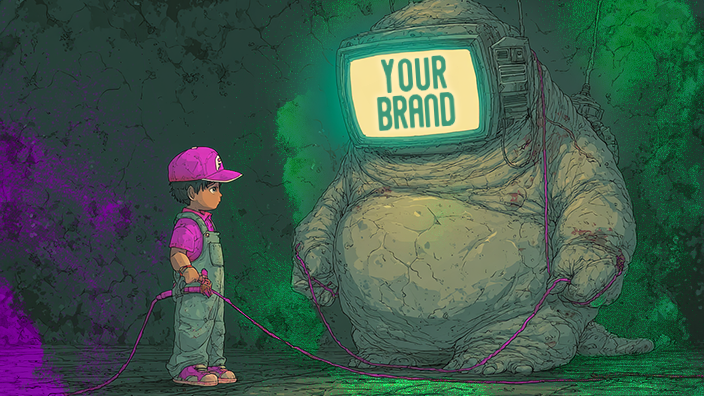
And right now? Most brands are starving theirs. Not intentionally. Just… quietly.
Why So Many Brands Feel “Fine” – and Still Don’t Work
We live in a world of clean templates, safe fonts, and brands that look acceptable everywhere but memorable nowhere.
Nothing is broken.
Nothing is offensive.
Nothing is compelling either.
That’s the danger.
A brand doesn’t fail because it looks bad. It fails because it looks like it could belong to anyone. And when customers can’t tell you apart, they default to price, convenience, or whoever showed up first.
Brand identity exists to prevent that.

Before You Pick Colors, Figure Out Who You Actually Are
This is where most teams rush and where things start going wrong.
Before logos, before mood boards, before typefaces, you need to answer one uncomfortable question: What do you stand for when no one is looking?
Not the aspirational answer. The real one.
Why do you exist beyond revenue? Who are you actually for, and who are you not for? What would you refuse to compromise on, even if it cost you money? What do people say about you when you aren’t in the room?
If you can’t answer those without sounding like a LinkedIn headline, your brand identity is going to feel hollow no matter how good it looks. Strong brands know their lane – and stay in it unapologetically.
Design Isn’t Decoration. It’s Decision-Making.
Here’s the part people misunderstand about visual identity: Good design isn’t about being clever. It’s about being clear.
Your logo should be recognizable without context.
Your colors should evoke something intentionally, not because they’re trending.
Your typography should match your personality, not fight it.
If everything is loud, nothing is memorable. If everything is minimal, nothing is distinct.
Design systems exist so your brand shows up the same way on a website, a social post, an invoice, or a billboard – because consistency is how memory is built.
Inconsistency is how trust erodes.
Voice Is Where Most Brands Give Themselves Away
You can tell when a brand hasn’t decided who it is the moment you read its copy.
Over-polished.
Over-explained.
Over-safe.
Brand voice isn’t about sounding smart – it’s about sounding like yourself, consistently, across every touchpoint. Your homepage, your ads, your emails, your social captions, even your support responses – they all either reinforce trust or quietly chip away at it.
If your brand voice disappears the moment something goes wrong, it was never real to begin with.
Consistency Is Boring. That’s Why It Works.
Most brands chase novelty. Strong brands chase recognition.
- Every interaction is a reinforcement opportunity:
- Does the website feel like the ad?
- Does the email sound like the sales call?
- Does customer support feel aligned with the brand promise?
There is no neutral interaction. Every touchpoint either strengthens the brand or weakens it.
The brands that win aren’t the loudest. They’re the most familiar.
Marketing Doesn’t Create a Brand. It Reveals One.
Ads don’t fix weak brands. They expose them faster.
If your positioning is unclear, paid media amplifies confusion. If your story is generic, content marketing multiplies indifference. The goal isn’t to “market harder.” It’s to market from something solid.
Tell real stories.
Share real convictions.
Let your brand be opinionated enough that some people opt out, because the right ones will lean in.
Final Thought from Exo 🦑
Brand building isn’t arts and crafts (sorry, Creatives!) It’s infrastructure.
It’s what lets you charge more without apologizing. Convert faster without pushing harder. And last longer when the market shifts.
So yes – pick your colors. Design your logo. Write your guidelines. But don’t forget to feed the thing underneath it all. Because a brand that isn’t nurtured doesn’t fade dramatically – it just becomes invisible.
And down here in the deep, invisibility is how you get eaten.
— Exo 🦑